Frank Cotton
The Hellbound HeartFrank Cotton is Rory’s missing brother, an obsessive seeker of forbidden experience whose attempt to open Lemarchand’s Configuration leaves him imprisoned beyond the ordinary world. His return through the walls of the family house turns his damaged body into a secret Julia protects and sustains, until he takes Rory’s identity and Kirsty exposes him.
Identity and the Configuration
Frank and Rory jointly inherit the house on Lodovico Street. By the time Rory speaks of his brother, Frank has been absent for a long time; Julia remembers seeing him a week before the wedding. His absence conceals a pursuit that began well before his imprisonment.
In Düsseldorf, where he had gone to smuggle heroin, Frank renewed his interest in stories about Lemarchand’s Configuration. He tracked down Kircher, who confirmed the box existed and agreed to let him have it in return for favors. Kircher’s instructions described solving the puzzle as a journey: the box was not merely a map of the way, but the way itself. Frank’s new fixation displaced his use of drugs and alcohol. He returned to the empty house and prepared for the puzzle with a discipline unlike his former habits.
As Frank neared the solution, a bell began to toll. He understood that it came from beyond the invisible door the box was made to open, and that Kircher’s promises were true. He expected the Cenobites, whom Kircher had described as theologians of the Order of the Gash. Frank believed his own idea of pleasure could meet theirs; that assumption proved disastrous.
Captivity and the return
The Cenobites subjected Frank to experiences he had understood as pleasure-seeking but that became extreme suffering. He could find no reliable distinction between reward and punishment, and his appeals for relief brought no mercy. The torment continued across weeks and months. When it stopped at last, the change was absolute: his senses vanished, and after several heartbeats he opened his eyes to find the room empty and the door closed.
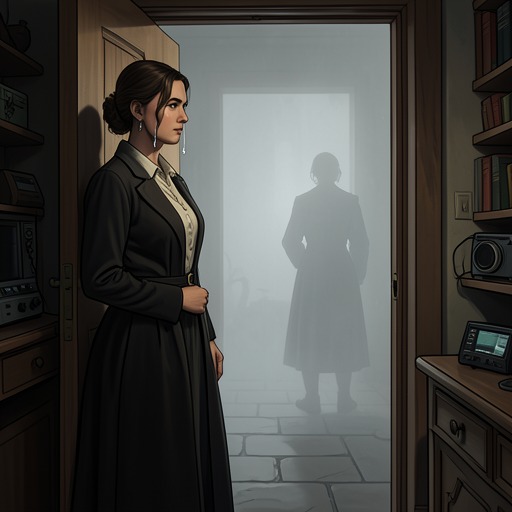
Frank remained trapped between the world Julia inhabited and another place associated with bells and darkness. From his confinement he could make only frail contact with the house. When Julia entered the Damp room, the wall briefly revealed a ruined human figure. The sight established that Frank was alive in some form, though his body was gravely incomplete and his condition too weak for him to explain.
His few words to Julia identified him and gave her an instruction: blood. Julia connected this plea to the blood Rory had previously lost in the room, which had disappeared from the floor. She concluded that Frank had drawn strength from it and began to consider what a greater supply might enable. The wall closed over him again, hiding him from view but not removing him from the house.
Julia’s killings and Frank’s reconstruction
Julia’s visits to the Damp room turn her recognition of Frank into action. When she brings a man upstairs, she attacks him with a knife; as his blood spills, she believes the room responds. In another killing, Frank’s presence in the corner accompanies the victim’s death, and he praises Julia afterward. These encounters show how her violence becomes the means by which Frank can regain strength and reach beyond his cell.
Frank’s return remains dependent on what Julia provides. He does not emerge as a restored person able to resume his former life; instead, the evidence of his damaged body and his need for blood keep his reconstruction partial and contingent. The house’s ordinary rooms and concealed cell become parts of the same arrangement: Julia moves between them, while Frank’s hidden presence gives her killings a purpose.
Rory’s identity and the final exposure
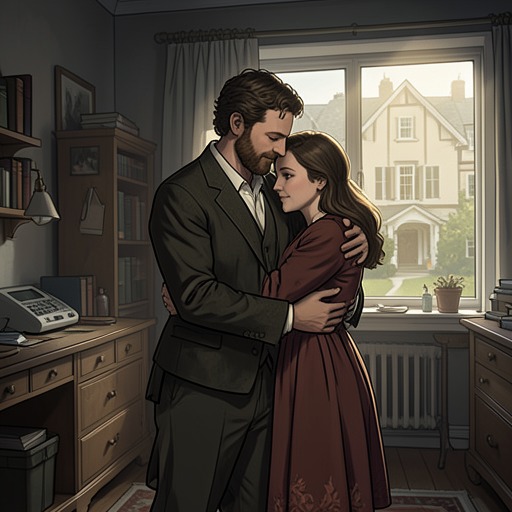
Frank’s restoration culminates in an appropriation of Rory’s appearance. Kirsty recognizes that the person speaking to her as Rory is Frank, while Rory’s corpse remains upstairs, covered by the bandages Frank had rejected. The borrowed face makes the brothers’ shared history a disguise: Frank can address Kirsty through familiar features, but the bells and her knowledge of the corpse lead her to identify the imposture.
Frank also confirms his presence to Julia while speaking in the role of Rory. Kirsty’s recognition breaks that concealment. When a Cenobite and three other disfigured figures appear, Frank looks back at Kirsty and acknowledges that she has brought about their arrival. One of the newcomers orders her to leave, taking control of the confrontation.
Narrative significance
Frank’s story repeatedly makes a threshold out of something familiar. Lemarchand’s Configuration opens a passage from a private room into the Cenobites’ domain; later, the walls of a family house become the boundary that both confines Frank and permits his contact with Julia. His final disguise extends the same instability from place to person: Rory’s face and voice appear to promise recognition, but they conceal Frank’s return.
The reversal also exposes the cost of Frank’s original mistake. He sought an experience he imagined could be mastered as pleasure, but the Cenobites’ understanding offered no dependable escape from suffering. His subsequent dependence on Julia, her killings, and finally Rory’s identity does not undo that captivity; it carries its consequences into the domestic world he once left behind.